Showing posts with label customer engagement. Show all posts

Tuesday, 30 March 2010

Waterstones - showing that Twitter can be fun for customers

There is a lot of coverage of companies getting social media wrong but less focus is placed on celebrating those who do it well. As an industry we need to be more positive and celebrate people who demonstrate creativity and innovation in their usage of social media. Last week I came across a Waterstones promotion available to its Twitter followers - the Golden Ticket Treasure Hunt.

The promotion
  • There are 10 Golden Tickets hidden around the website
  • Waterstone's tweets a clue to each one
  • Followers scramble the site using their clue solving skills to locate the golden ticket
  • Followers then email when they have found it
  • First correct reply wins the prize
  • Different prize for each Golden Ticket
  • Prizes are showcased on landing pages linked to via Twitter
  • Additional clues are given from time to time


The benefits
  • Greater engagement of Twitter followers - during each treasure hunt Waterstones is talking to its followers
  • Driving traffic to the eCommerce website
  • Customers spend more time looking around the site to solve the clues
  • Increase product views and appreciation of range diversity
  • Ancillary sales generated off the back of this activity.

Whilst the format is hardly revolutionary (Willy Wonka anyone?), the delivery was neat and fun. And this is where I think social media has great potential - driving brand engagement by giving people something of interest that they can play with. We all like to be distracted for a while and business doesn't always have to be serious.

I would love to find out the actual impact of site traffic s0 have asked Waterstones via Twitter. I will update this blog if they are able to share the information.

*UPDATE*
The kind peeps @Waterstones have shared this info:
"We've had double the usual traffic from Twitter, and as you can see we've had 882 new followers in 2 wks"

So what do you think? Clever marketing or not?

Friday, 21 August 2009

Why social media makes Customer Service more important

I spoke to a friend last night who visited Iceland for his first wedding anniversary. He had treated his wife and splashed out on the Hilton which is apparently the second best hotel in Iceland.

On arrival he was greeted with the news that the hotel manager had upgraded their reservation to the executive suite, on one of the top floors, affording spectacular views over Reykjavik. The reception staff wished my friend and his wife a happy anniversary and told them to shout if they need anything to make their stay more pleasant. When they got up to the room, there was a greeting card congratulating them and a bouquet of flowers.

Now that is what I call customer service. The hotel knew about the special occasion because my friend added this to the comments field when booking online. However, the fact that the manager made the effort to give them something for nothing and that the hotel staff were all aware of the importance of the occasion is testament to a company that takes customer service seriously.

As a result of this kindness, my friend has recounted the story to almost everyone he knows. He added an update to his Facebook account when he was over in Iceland saying how happy he and his wife were. That message instantly reached hundreds of people. Following a conversation in a pub, I'm now writing about this and will link to it across my social networks.

Why? Because it illustrates the point that positive customer service can have a ripple effect. One of the positive effects of social media is the ability for individuals to influence decision making via user generated content. This content could be on a social network like Facebook, in a Twitter tweet or in a review posted on a website. The fact is, with people sharing information (in some cases instantly) freely, the impact the actions your business takes can have a significant impact on your brand reputation.

If you look back to the problem United Airlines created for itself when it damaged a customer's guitar, it provoked a chain reaction from the video posted to YouTube which amassed over 2m views from July 7th to July 12th after the story broke. The company's reputation was tarnished and they had to respond, eventually providing positive customer service. Social media provided the tools for an individual to express his frustration by the inept customer service he was provided. This social commentary influenced the opinions and actions of thousands of people globally.

For brand marketers and PR, I think this concept is proving hard to handle and also quite daunting. No longer can you rely on press releases to spin a positive line, you have to monitor brand conversations across the social space and learn to engage with people on their terms and in their networks. Communication is more pervasive than ever and companies have to respond by taking customer service seriously across the business; the adage that the customer is always right is truer than ever and how business deals with its customers is wonderfully visible.

Why has social media changed the requirements for customer service? Because an individual can influence people globally which in turn can have a significant impact on a business. Perhaps investors will take stock and impress the value of good service on their management team because ignoring it could affect the value of their investments.

Do you agree that social media is making customer service standards more visible and more important?

Friday, 3 April 2009

Should we expect responses from all Twitter messages?

Following some twitter banter this week i've decided to continue the political theme of last week's post. Don't worry, i'm not politicising my blog, I'm just interested by the usage of social media by politicians and political parties.

Last week's blog discussed the relevance of social media to politics; this week's reviews how a poorly thought through campaign can increase apathy amongst the target, or voting, audience. As with any social media presence, politicians need to understand the rules of engagement; if they want the kudos and benefits of our attention and affection, they need to take it seriously and give something back. In short, I think they have the following obligations:

  • Respond to comments and feedback
  • Maintain regular updates
  • Don't preach - give us opinion but let us think about it
  • Address negative PR
  • Entertain us!
I, like one man and his dog, follow Downing Street on Twitter. I guess I'm intrigued to see the Labout spin monster in motion but also the pure part of my heart longs for genuine engagement from a politician. This week I decided to post a reply to a tweet from Downing Street:

Granted, there was a certain cheekiness and provocation in this tweet but it was also playful and genuinely hoping for a response. I took the time to communicate with Downing Street so surely they would want to respond to create a positive impression? Wrong. 2 days later and still nothing.

In my view, if you accept me as a follower you should take me seriously and respond to my comments. If you had no intention of responding to all individuals, then at least make that clear in your bio or by putting a background to your twitter account with a short statement. When I use twitter I expect a response - everyone else i message achieves this.  That is what engagement is about. Twitter is not a marketing tool to push information at people - it is a conversation tool to interact and share content; without the interaction it is a PR stunt.

So tell me what you think - am I being unreasonable in expecting the Downing Street behemoth to respond to individual comments, however banal? Or should we demand better service from a public body that obviously wants the benefits of having a large follower base?

Please let me know your thoughts by posting comments to this blog.

Friday, 6 March 2009

Why shouldn't you use customer reviews on your site?

It has been a busy week @ e-inbusiness. With lots of new prospects on the horizon, the e-inbusiness roadshow has been from town to town. Like the littlest hobo, every place I stop, I make a new friend etc…….


I’ve spent a lot of time in the past 2 weeks talking to people about social media. Some rooms fall silent and the tumble weed rolls. Others erupt into debate between advocates, sceptics and those who just love sitting on that fence. Social media has polarised the business community! I know that some social enthusiasts are vexed by this but I say game on. I would rather the discussion provoke a response rather than apathy. At least with negativity there is an emotional reaction you can dare to influence, perhaps change. The conquest for the new frontier has begun. In this week’s blog I’m going to take one element of social media, customer ratings & reviews, and explore its potential in more depth. Of all the forays into engagement and buzz, I think this is the easiest for people to conceptualise and ‘get’ and there are a lot of stats floating around to beef up the business case.


For those new to user generated content, ratings & reviews enables online shoppers to post reviews of products & services that they have bought. The usual mechanism is to send the customer an email X days after purchase, inviting them to rate pre-defined criteria such as product quality. The customer clicks on a link to a webpage where they can complete the review. This review is then posted to the review engine (could be bespoke on your site or an integrated 3rd party solution like BazaarVoice, Feefo & Reevoo).


Why should you take reviews seriously?

Quite simply, if you don’t you will lose business. People read reviews and are influenced by them. If you don’t have reviews on your site, you will lose people to competitors who do. It really is that straight forward. I personally use reviews all the time for products I don’t know enough about, such as digital cameras. I want to know that the person I’m buying from is reliable and I’m getting value for money. I also want to know it does what is says on the tin. I am actually disappointed when sites don’t offer me reviews, surely it is in Maslow’s hierarchy of needs now!

And here is the dry bit, the research findings from JupiterResearch:

  • 77% consumers cite reviews as being useful in making a purchase online
  • 61% report that confidence can be increased via independent reviews
  • Petco experienced a 49% increase in conversion for products with reviews

Still not convinced, take a trawl around the web and in particular BazaarVoice’s website. Yes they have an interest in converting you to the cause but the research they cite is all independent. The facts speak for themselves.


What are the commercial benefits?

  • Increased product conversion
  • Increased average order values
  • Greater trust
  • Improved customer engagement
  • Great SEO content to increase your visibility


Why would my customers be interested?

Why wouldn’t they? 65% consumers research a retailer’s reputation before purchasing, according to an Internet Retailing article. Reputation is becoming increasingly important online, as is quality and trust. The economic climate is also influencing consumer behaviour. People are spending more time researching to get the best deal, not just on price but on quality & service.

Providing reviews adds reassurance, it says “listen to what people like you think”. It benefits your visitors and also your customers who can share their experiences with others. I actually like the idea that my opinion counts and can influence others – if I get great service, I want others to know so that they can benefit too.

An interesting stat this is doing the rounds is that 32% of consumers are willing to write an online review but only 19% would be prepared to write a letter or email a company directly.


How can I get people excited by this service?

Think differently. Don’t just stick the review content on your website and pat yourself on the back. Work out how you can communicate your customer’s opinions across your customer channels to increase visibility. Here are some winning ways to use reviews:

  • Advertise review content in your emails – “As voted by our customers”
  • Promote reviewed products in offline marketing such as display advertising & TV
  • Interact with your main reviewers, encourage them to become advocates
  • Integrate review ratings with your search marketing – powerful impact when a search ad has a “customers rate this 5/5” promotion

To give a few recent examples:

Argos

Argos recently added reviews on key products in its printed catalogue which reaches over 17m UK customers, 2/3 of all households

Free People

The US clothes etailer invited its most prolific reviewer to an in-depth interview, asked her about her life and why she likes Free People, snapped her in their clothes, then uploaded the photos to their Flickr group, dedicated a blog to the interview on their website and talked about it across other social platforms.


Being creative

Mobile shopping is taking off. Every time someone walks into a store with a mobile device, there is an opportunity to influence them via mobile marketing. In regards to reviews, you can promote online reviews on display stands, allowing customers the chance to read reviews of your products before making a purchase. This can increase in-store conversion be driving messages of quality, trust and reassurance. Also, if your products is syndicated in retail outlets and is up against competition, strong display stands with customer review options will help differentiate your offering.

A great example of this comes from Bazaarvoice’s customer, TurboTax. They launched a national campaign in the US to allow in-store customers to read views via their mobiles.


The summary

My view? Consumer feedback has become standard, it is no longer a novelty. What is creative is how brands are using reviews in a multi-channel environment to increase engagement. We all want honesty and transparency and from that trust will come. Don’t ask “why should I use reviews”, ask yourself “why shouldn’t I use reviews”.

Friday, 6 February 2009

Dialogue is better than monologue: building engaged communities online

Month 2 in the 2009 Social Brother diary room….

I’ve been locked in a cellar with only my iPod for company as I write a presentation for the Retail Week eCommerce Summit on 17th Feb @ which e-inbusiness is the Associate Sponsor. Yes, a shameless chance to further our global domination plan by drip feeding our knowledge and experience to innocent bystanders!

For those of you who have ever given a presentation to a demanding and savvy audience, it can be quite a daunting task. Not only do you have to provide a voice of authority and knowledge, you have to be engaging and interesting. I’ve always prided myself on being able to keep people’s attention but that’s usually fuelled by some premium ales and the odd Jack Daniels, or two. I was set the challenge by Sarah, our Head of Corporate Marketing, and Steven, our Sales & Marketing Director – what should we talk about that is current, topical and relates to user experience and the use of technology to drive online conversion?

After two days of spiritual meditation in an ancient Buddhist temple in the Himalayas, entering into a zen like trance (anyone seen Monkey Dust?!), I came up with the thread of building engaged communities online by creating a buzz for your brand. Before the corporate bingo police come rushing in, that’s not just marketing waffle. I’m not trying to cram in agencyspeak to sound uber-modern. I genuinely believe that this is the key challenge for online brands in 2009 and onwards; how do you excite and interest your customers to build a community that actively engages with your brand? This week’s blog looks at what I mean by an engaged community and the power of advocacy in helping brands grow a community organically.

Yakety yak – what is an engaged community!?

Noun

Engagement (plural engagements)

1/ connection or attachment, the point at which two or more things are connected

2/ a feeling of understanding and ease of communication between two or more people

An engaged community is a group of people who have a common interest in your brand, who interact with each other and your company to access interesting, relevant information and share it across their social networks. Each member contributes to the community but some are more active than others and take leading roles. Your community requires support and your main challenge is to provide them with the tools & technology to use your content when, where & how they want. The community thrives on nurture and nature; your nurture to provide advice & guidance and moderation when needed to help the members, nature for your members to grow the community organically via their personal connections and advocacy and most importantly, on their terms.

Encouraging advocacy

This is about dialogue, not monologue. When you have engaged with customers, you can talk to them regularly and update them with relevant information. You can signpost them to important announcements and build a personal relationship. Then you can encourage them to share your content with their contacts and other social networks. By rewarding and encouraging, you gradually build up a base of brand advocates who trust you, like what you offer and will tell their connections. Check out how well Wiggly Wigglers has done on Facebook at linking product enthusiasts. Heather Gorringe has really embraced social media and put her customers at the heart of the communication – I have told hundreds of people about them because of this, who could have told hundreds more. As Diana Ross said, we’re in the middle of a chain reaction….

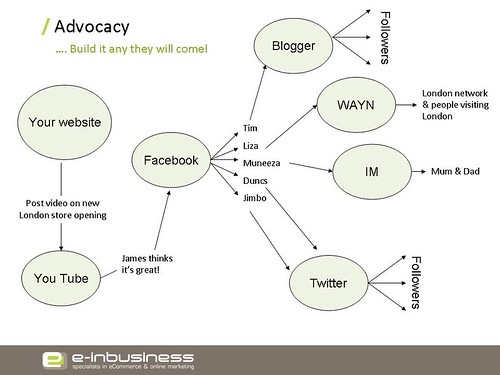
Putting this into practise – visualising advocacy

Below is a Blue Peter special sketch of how the One-to-Many power of advocacy can positively impact brand awareness (and eventually conversion and other KPIs) by dialogue:


e-inbusiness brand advocacy diagram

This is all very top level stuff but it does illustrate the power of engagement. If brands look to social media as the cure all for the tough economic and trading conditions, they will be missing a beat. I think people need to encourage engagement, giving their customers the tools & support to interact with their brand and content on their terms, when, where and how they want. Social media is just one element of this, albeit an important and hugely exciting one.

What do you think? Is engagement the new black, or are you one of the doubters? If you want to hear more, please come and listen to us at Retail Week eCommerce Summit on February 17th @ Millennium Gloucester in London.